

Table of Contents
- Why Grooming Sends Some Dogs Over Threshold
- Signs of Grooming Stress in Dogs: Read the Body Language First
- Step 1: Build a Calm Grooming Environment at Home
- Step 2: Desensitization Training for Dog Grooming and Counter-Conditioning
- Step 3: Choose the Best Grooming Tools for Nervous Dogs
- Step 4: How to Groom an Anxious Dog Safely, Area by Area
- Step 5: Calming Aids, Session Length, and When to Call a Professional Groomer
- Conclusion: Patience Beats Pressure
- Frequently Asked Questions
Last Updated: September 13, 2026
Why Grooming Sends Some Dogs Over Threshold
If your dog trembles at the sight of nail clippers, you're in the majority. According to owner-reported prevalence and severity of fear and anxiety in dogs, 35.2% of dogs show at least mild to moderate fear of nail trimming, while 22.3% fear other grooming activities. Separate research from Texas A&M University's 2026 canine anxiety study found that more than 84% of dogs display at least mild fear or anxiety in everyday situations.
That's the core problem: you're not managing a "difficult dog." You're managing a nervous system that has crossed its threshold, where stress tips into fight, flight, or freeze. This guide from Prime Picks walks through seven calm steps to groom anxious dog safely, from reading body language to knowing when a professional groomer is the better call.
Signs of Grooming Stress in Dogs: Read the Body Language First
Learning the signs of grooming stress in dogs is the single most useful skill you can build. Most owners notice the growl but miss the quieter signals that come first.
Watch for these behavioral cues:
- Lip licking, yawning, or whale eye (whites showing)
- Tucked tail, lowered head, or freezing mid-brush
- Ears pinned back flat against the skull
- Sudden shedding or dandruff during handling
- Pulling away when you approach paws, ears, or tail
Any of these means you've crossed the threshold. Stop, give a treat, and end on a calm note. Pushing through teaches your dog that grooming predicts fear.
Step 1: Build a Calm Grooming Environment at Home
The grooming environment does more work than most owners expect. A 2026 low-stress grooming guide by Stephanie Zikmann recommends science-based environmental modifications, including soft color palettes (blues, purples, soft greens) and choosing the right grooming table surface to reduce stress.
Set up your space:
- Pick a quiet room away from foot traffic and loud appliances
- Place a non-slip mat or towel on a stable surface
- Lay out tools before your dog enters, so nothing surprises them
- Keep sessions short; five minutes counts as a win
- Warm the room slightly; cold surfaces increase tension
A calm environment won't fix anxiety on its own, but it removes easy triggers that stack against you.
Step 2: Desensitization Training for Dog Grooming and Counter-Conditioning
Desensitization training for dog grooming works by pairing tools with treats before they ever touch your dog. It's the part most owners skip, and the part that determines whether the next six months are calm or chaotic.
Desensitization and counter-conditioning are not the same thing. Desensitization means exposing your dog to a trigger at an intensity so low it doesn't produce fear, then gradually increasing intensity. Counter-conditioning means changing the trigger's emotional meaning by pairing it with something the dog loves. You need both, in that order, crank up intensity before the emotional pairing takes hold and you're just practicing fear.
The threshold rule that governs everything
Every step below only works if your dog stays under threshold, where stress tips into fight, flight, or freeze. Signs you've crossed it: lip licking, yawning, whale eye, freezing, tucked tail, sudden shedding. If you see any, you went too fast. Back up one step and repeat it for three sessions before advancing.
A structured 4-week protocol
This is the sequence most veterinary behaviorists and fear-free practitioners use. Adjust the pace to your dog; some need two weeks per phase, others move faster.
Week 1, Tool presence only. Leave the brush, clippers, and nail grinder on the floor where you hang out. Don't pick them up. Toss a treat near the tool every time your dog looks at it. Goal: the tool predicts cheese, not handling.
Week 2, Tool in hand, no contact. Pick up the tool, hold it for two seconds, treat, put it down. Repeat 10 times per session, two sessions per day. Goal: your dog stays relaxed when the tool is in your hand.
Week 3, Tool touches body, no work. Touch the back of the tool to your dog's shoulder for one second. Treat. Release. Then a paw, ear, then tail, one body part per session, never chained. Goal: contact predicts a treat, not a procedure.
Week 4, Simulated work. Clip one nail (or make one brush stroke), then stop and treat generously. One repetition per session for three days, then two, then three. Goal: the procedure becomes the predictor of reward.
The three mistakes that undo the work
- Advancing on a good day. One calm session doesn't mean your dog is ready for the next phase. Wait for three consecutive calm sessions.
- Treating after the fear response. If your dog flinches and then you treat, you've rewarded the flinch. Treat before the trigger, during the calm, and right after the release, not after a stress signal.
- Skipping the release. Every repetition must end with your dog choosing to stay or walk away. Holding them in place isn't training, it's restraint.
When to bring in a professional
If four weeks of consistent daily work produces no measurable improvement, your dog still shows fear signals at Week 1 intensity, the problem is likely beyond basic counter-conditioning. A veterinary behaviorist (DACVB) or certified fear-free trainer can assess whether the anxiety is situational or part of a broader disorder, and whether a short-acting medication protocol should run alongside training. Training alone rarely resolves a clinical anxiety disorder; training plus medical support often does.
Step 3: Choose the Best Grooming Tools for Nervous Dogs
The best grooming tools for nervous dogs share three traits: they're quiet, they don't pull, and they let you work in short bursts. A 2026 industry report from Groomers-Online's Dog Grooming Style Report recommends professional grooming visits every 6 to 8 weeks even for short-haired dogs, because shorter sessions mean less accumulated stress.
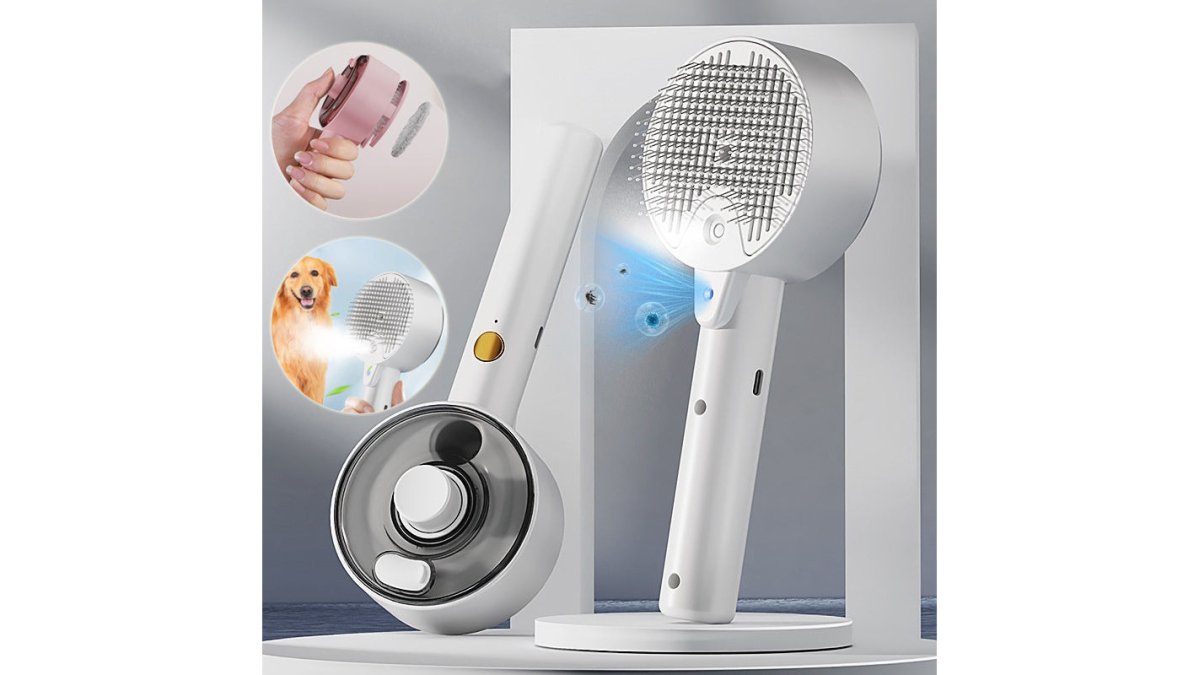
At Prime Picks, we look for tools that solve specific anxiety triggers rather than adding features. The Animal Hair Remover Brush combines a fine, soft needle design with a light mist and UVC blue light, so you get sterilization and hair care in one pass without the pulling that sets nervous dogs off.

| Tool Type | Best For | Avoid If |
|---|---|---|
| Soft-bristle brush | Short daily sessions | Coat is heavily matted |
| Quiet clippers | Sound-sensitive dogs | Dog startles at vibration |
| Nail grinder (low speed) | Thick nails, quick trims | Dog fears buzzing sounds |
| Steam or mist brush | Loose hair, sterilization | Dog dislikes moisture |
Step 4: How to Groom an Anxious Dog Safely, Area by Area
Work from least to most sensitive areas, and never chain two stressful zones in one session. The sequence:
Body and back first. Use slow strokes with your brush, following the coat direction. Rest one hand on your dog's side for calming touch.
Paws next. Hold each paw for a few seconds before touching a nail clipper. Clip one nail, treat, release.
Ears and face last. Use a damp cloth rather than tools near the face. Most dogs tolerate this far better than clippers.
The tail is not a handle. Avoid restraint here; a dog that feels trapped near the tail will escalate fast.
If your dog freezes or pulls away at any point when you groom anxious dog, that's your cue to stop for the day.
Step 5: Calming Aids, Session Length, and When to Call a Professional Groomer
Calming aids reduce baseline stress so training has room to work. They don't replace desensitization, they buy a lower starting point and can shave weeks off the protocol.
Calming aids that actually do something
- Lick mats and snuffle mats. Licking and sniffing are self-soothing behaviors wired into the canine nervous system. Smear a lick mat with peanut butter (xylitol-free) or plain yogurt and freeze it for a longer-lasting distraction during nail trims.
- Happy Hoodies and ear wraps. These apply gentle pressure over the ears and muffle the high-frequency sound of dryers and clippers, the two sounds most likely to spike a nervous dog. Introduce them during a calm moment days before grooming, not mid-session.
- Body wraps and anxiety vests. Constant, gentle pressure calms many dogs, similar to swaddling. Fit matters: too loose does nothing, too tight adds stress.
- Pheromone sprays and diffusers. Dog-appeasing pheromone products mimic the scent a nursing mother produces. Evidence is mixed but risk is low, so trial them in the grooming space 30 minutes before you start.
- White noise or a fan. Masking clipper and dryer sounds is often more effective than desensitizing to the sound itself.
Session length guidelines:
- Puppies and seniors: 5-10 minutes
- Adult dogs in training: 10-15 minutes
- Established routines: 20-30 minutes maximum
End every session on a win, even if that means stopping after one nail. A 90-second session that ends calm is worth more than a 20-minute session that ends in a struggle.
The handover checklist for professional groomers
If you're handing your dog to a professional, the most useful thing you can do is write down what you've learned at home. Most groomers work blind on a first visit. A one-page handover sheet changes that.
Include:
- Triggers. Which tools, sounds, or body parts set your dog off, and in what order.
- Calming aids that work. Does your dog settle with a lick mat? Does a Happy Hoodie help or make it worse?
- Treats and timing. What treats your dog will actually take under stress, and when to offer them.
- Stop signals. The specific body-language cues your dog shows right before escalating.
- Vet contact. Your veterinarian's name and number, plus any medication protocol already in place.
- What not to do. If restraint, scruffing, or a specific piece of equipment makes things worse, say so explicitly.
Ask the groomer to note what worked and what didn't so you can adjust the home protocol before the next visit. Consistency between home and salon makes the training stick.
When to call a professional, and which kind
- Fear-free certified groomer. For dogs with mats, overgrown nails, or anxiety that's improving but still needs a skilled hand. Look for Fear Free or equivalent low-stress handling certification.
- Veterinary behaviorist (DACVB). For dogs whose anxiety doesn't improve after 4-6 weeks of consistent home desensitization, or whose fear generalizes beyond grooming to handling in general.
- Veterinarian. For situational medication evaluation. Short-acting options like gabapentin or trazodone are commonly prescribed for pre-grooming or pre-vet-visit anxiety in severe cases. They take the edge off without knocking the dog out, letting the training protocol take hold instead of being drowned out by fear.
Post-grooming decompression
Most guides stop when the tools go down. That's a mistake. The 30-60 minutes after a session are when your dog's nervous system is still elevated, cortisol doesn't drop the moment the clippers turn off. What you do in that window shapes how your dog remembers the experience.
- Give them space. Don't crowd, praise excessively, or immediately offer a bath or walk. Let them choose where to settle.
- Offer a decompression spot. A quiet bed in a low-traffic room, away from the grooming area, gives your dog a place to downshift. A familiar scent and soft surface help.
- Skip the celebration. High-energy play or a big reward right after a stressful session can re-elevate an aroused dog. Save it for the next calm moment.
- Watch for the 24-hour tail. Some dogs show delayed stress, clinginess, appetite changes, or avoidance of the grooming room, for a day after. If you see it, note what happened and adjust next time.
- Log the session. Two lines in a notebook: what you did, how your dog responded. Patterns emerge fast and show whether the protocol is working.
Conclusion: Patience Beats Pressure
The industry pushes groomers to "get the job done" quickly, and that pressure is exactly what anxious dogs can't handle. Slow, spaced sessions with positive reinforcement always beat one forced marathon.
Prime Picks carries the gentle tools that make this easier: the Animal Hair Remover Brush for pulling-free brushing with built-in sterilization, and the Luxury Dog Bed with hidden storage for a calm post-grooming decompression spot. Get started with Prime Picks and turn grooming from a battle into a routine your dog can tolerate, then enjoy.

Frequently Asked Questions
What do you do if your dog won't let you groom it?
Stop and reset rather than push through. Start with one-second touches on a low-sensitivity area like the shoulder, pair each touch with a treat, and end the session while your dog is still relaxed. Desensitization training for dog grooming works in small, repeatable steps. If your dog still panics after several short sessions, ask your veterinarian about a fear-free or cooperative-care groomer.
How long should a grooming session last for an anxious dog?
Keep sessions to 5-10 minutes at first, then extend gradually as your dog stays under threshold. Professional grooming visits are recommended every 6-8 weeks (Groomers-Online, 2026) to maintain coat health and minimize how long each session needs to run. Short, spaced-out sessions beat one long marathon every time for a nervous dog.
Are there specific tools that help reduce grooming anxiety in dogs?
Yes. The best grooming tools for nervous dogs are quiet, low-vibration clippers, soft slicker brushes with coated tips, and a grooming table with a non-slip surface. The Animal Hair Remover Brush Dog And Cat Steam Brush from Prime Picks ($45.55) uses a fine, soft needle design that is comfortable without pulling or tugging, and its light mist helps calm the coat during brushing.
How can I safely sedate my dog for grooming?
Only a licensed veterinarian can prescribe sedation, and it should be a last resort after behavior work. Before that step, try environmental changes like a quiet room, a lick pad, and a Happy Hoodie. Medical anxiety management is a real option for severe cases, so talk to your vet about your dog's specific triggers and history rather than using any over-the-counter product.