

Table of Contents
- Why the Right Hair Accessories Matter for Your Daily Routine
- Essential Hair Accessories for Everyday Wear
- Gentle Hair Ties for Daily Use
- How to Style Hair with Accessories
- Best Hair Clips for Thin Hair
- Matching Accessories to Your Hair Type
- Building a Capsule Collection of Hair Accessories
- Frequently Asked Questions
Last Updated: September 16, 2026
Why the Right Hair Accessories Matter for Your Daily Routine
The global hair accessories market hit $27.14 billion in 2026, according to Business Research Insights market analysis, and it is projected to reach $58.82 billion by 2035. That growth says something simple: people are buying more accessories, but not necessarily better ones. At Prime Picks, we see the same pattern in what shoppers ask us. The best hair accessories for daily routine are not the trendiest ones sitting in your feed.
Essential Hair Accessories for Everyday Wear
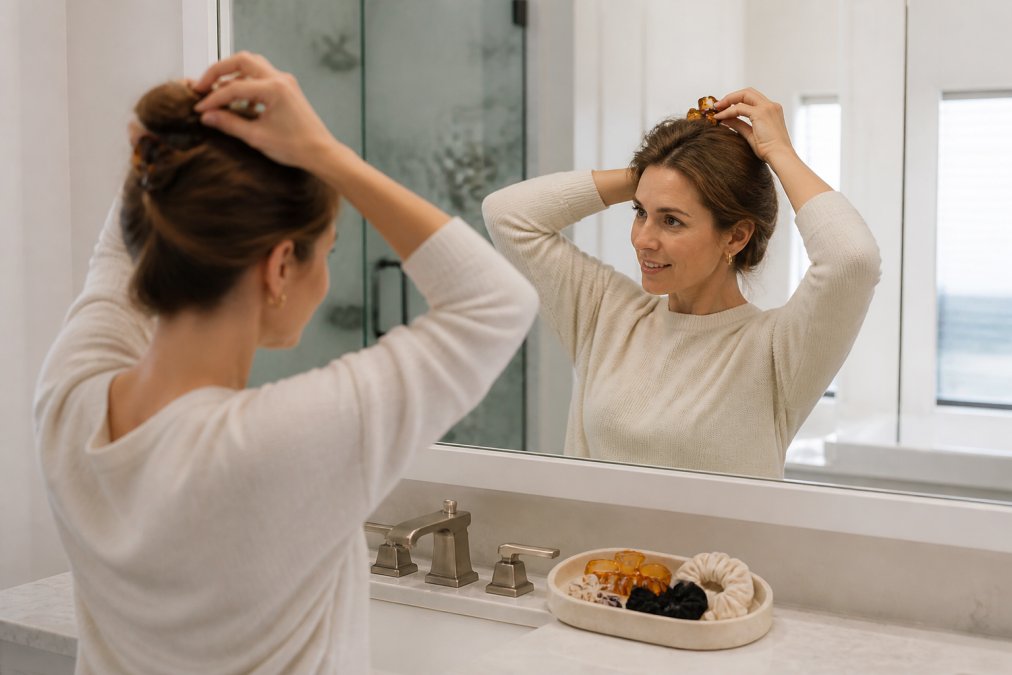
Five categories cover almost every daily styling need: claw clips, silk or satin scrunchies, headbands, barrettes, and gentle hair ties. Most people only need two or three to handle a full week.
Claw Clips
Claw clips remain the dominant daily accessory for 2026, with current trends shifting toward sculptural shapes and tortoiseshell finishes, according to Marie Claire's summer 2026 accessory report. The reason is practical, not just aesthetic. A medium claw clip holds a full twist in place without a single elastic band touching your hair.
Silk and Satin Scrunchies
Silk and satin scrunchies are a top 2026 trend specifically because they reduce friction and help prevent split ends, per HairClipSupplier's 2026 trend analysis. That functional benefit is what separates them from standard cotton elastics, which grab and tug at the cuticle every time you pull your hair back.
Headbands and Barrettes
Padded velvet and braided headbands are trending for daily wear in 2026, alongside minimalist barrettes for quick fixes and office styling. A good padded headband adds volume at the crown without the pressure of thin plastic bands.
Gentle Hair Ties for Daily Use
Gentle hair ties for daily use hold a ponytail securely without creasing or snapping strands. The two best options are silk-covered elastics and coil ties, both of which distribute tension instead of concentrating it.
| Tie Type | Best For | Hold Strength | Crease Risk |
|---|---|---|---|
| Silk scrunchie | Fine, straight hair | Medium | Low |
| Coil tie | Thick, curly hair | Strong | Very low |
| Satin-covered elastic | All hair types | Medium | Low |
| Standard elastic | Not recommended daily | Strong | High |
How to Style Hair with Accessories
Styling with accessories is faster than heat styling once you understand one principle: anchor first, decorate second. The anchor is the piece doing the holding (claw clip, coil tie, snap clip). The decoration is everything else. Most bad hair mornings happen because people reach for the decoration before the anchor is set.
Quick Morning Styles
The two-minute twist. Gather hair as if making a low ponytail, then twist the length upward into a loose rope. Fold the rope against the back of your head and clamp a medium claw clip over the fold, not the ends. Clamping the ends puts tension on a few strands and the clip slides out by lunch; clamping the fold spreads tension across the widest part of the twist.
Professional Looks
For a polished office look, a padded headband does most of the work. Pair it with a sleek low bun secured by a coil tie, and the whole style reads intentional without looking fussy. Neutral-toned claw clips and barrettes are increasingly used for professional daily styling, according to Alexandre de Paris 2026 accessory trends.
- Match the metal. If your earrings are gold, your barrette hardware should be gold. Mixed metals read as unfinished in an office setting.
- Keep the silhouette smooth. A claw clip placed at the crown reads polished; the same clip placed at the nape reads casual. Placement, not the clip itself, sets the tone.
- Limit to two accessories. A headband plus a barrette is a look. A headband plus a barrette plus a claw clip is clutter.
Troubleshooting the Three Most Common Failures
The clip slides out by mid-morning. This is almost always a size mismatch, not a grip problem. Fine hair needs a 3-4 cm clip; medium hair 5-7 cm; thick hair 8 cm or larger. If the right size still slides, your hair is too clean, day-two hair holds accessories better because natural oils add friction.
Best Hair Clips for Thin Hair
The best hair clips for thin hair are small or medium claw clips with tight teeth and matte finishes, plus flat snap clips that grip without sliding. Thin hair has less volume to anchor against, so size matters more than style.
Professional Wireless Hair Straightener →
Here is what actually works for fine strands:
- Small claw clips (3-4 cm): hold a half-up twist without gaping
- Flat snap clips: sit close to the scalp and stay put through the day
- Miniature jaw clips: good for sectioning and pinning bangs
- Avoid: oversized clips, heavy metal barrettes, and smooth plastic clips that slide
Matching Accessories to Your Hair Type
Most guides sort accessories by hair type and stop there. The useful version explains why a coil tie works on coily hair and a silk scrunchie on fine hair, the mechanism, not the label, determines whether an accessory helps or damages your hair.
Three mechanisms drive every match:
- Friction. Smooth fabrics (silk, satin) let hair slide, which reduces cuticle wear but also reduces grip. Textured fabrics (velvet, cotton) grip better but abrade the cuticle with repeated use.
- Tension distribution. A coil tie spreads tension across a spiral; a standard elastic concentrates it at one point. Concentrated tension is what causes breakage and creases.
- Edge geometry. Seamless, rounded edges glide over the cuticle. Molded seams and metal joins catch and snap strands, this is the single most common cause of mid-shaft breakage from accessories.
- Fine or straight hair: silk scrunchies (low friction, enough grip on smooth strands), small claw clips with tight teeth (3-4 cm), flat snap clips with rounded edges, thin fabric-wrapped headbands. Skip oversized clips, fine hair doesn't have the volume to anchor them.
- Thick or wavy hair: large claw clips (8 cm+), coil ties, wide padded headbands. Thick hair needs surface area, not tighter grip. A tight accessory on thick hair creates pressure points at the scalp.
- Curly or coily hair: coil ties, satin scrunchies, seamless snap clips with smooth edges. Curly hair is the most fragile at the bend, so anything with a seam or a metal join is a breakage risk. Satin also preserves curl definition better than cotton, which absorbs moisture and causes frizz.
- Damaged or fragile hair: silk and satin only, no metal edges, no tight elastics, no claw clips with sharp teeth. Treat the accessory as a protective tool, not a styling one.
The Damage-Prevention Checklist
Before an accessory earns a spot in your daily rotation, run it through these four checks:
- Run a fingernail along the edge. If it catches, it will catch your hair. Seamless construction is non-negotiable for daily wear.
- Check the hardware. Some standard metal barrettes contain nickel, which can trigger contact dermatitis with daily wear, according to Kosmart's 2026 material guidance. If you have sensitive skin, look for nickel-free or coated hardware.
- Test the tension. The accessory should hold without leaving a mark after 30 minutes. A mark means the tension is concentrated, not distributed.
- Check the removal. If you have to pull the accessory out, it's damaging your hair on the way in and out. A good daily accessory releases with one hand.
Building a Capsule Collection of Hair Accessories
A capsule collection of hair accessories is a small set that covers every daily situation without duplicates. Most people need six items, not sixty.
Build yours around these six:
- One medium claw clip for full twists
- Two silk or satin scrunchies for ponytails and wrists
- One padded headband for polished days
- Four flat snap clips for sectioning and bangs
- Two coil ties for secure, crease-free hold
- One set of minimalist barrettes for front sections
Frequently Asked Questions
What are the must-have hair accessories for everyday wear?
A claw clip, a few silk scrunchies, a padded headband, and a set of snap clips cover most daily needs. Claw clips hold hair securely without creasing, silk scrunchies reduce friction and breakage, headbands add polish on rushed mornings, and snap clips manage stray pieces. These four types work across hair textures and keep your routine simple.
How do I choose hair accessories that won't damage my hair?
Look for smooth materials and gentle closures. Silk and satin scrunchies cause less friction than standard elastics, and claw clips distribute tension instead of pulling at one spot. Avoid metal barrettes with exposed nickel if you have sensitive skin, since contact dermatitis is possible.
What are the best hair clips for thin hair?
Small and medium claw clips work well for thin hair because they grip without slipping. Mini jaw clips and flat snap clips also hold fine strands securely. Avoid oversized clips that slide out or heavy metal barrettes that weigh hair down.
What hair accessories are trending in 2026?
Sculptural claw clips in tortoiseshell and resin finishes, oversized satin ribbon bows, pearl-embellished clips, padded velvet headbands, and minimalist barrettes are the standout trends for 2026. Silk and satin scrunchies remain popular for their hair-friendly benefits. Neutral-toned claw clips and barrettes are also favored for polished, professional daily styling.
How can I style my hair quickly with accessories in the morning?
Keep a claw clip, a silk scrunchie, and a headband within arm's reach. A claw clip twists and secures medium to long hair in seconds. A scrunchie makes a messy bun or ponytail without creasing. A padded headband adds volume and covers roots on days you skip washing. These three items handle most rushed mornings.